
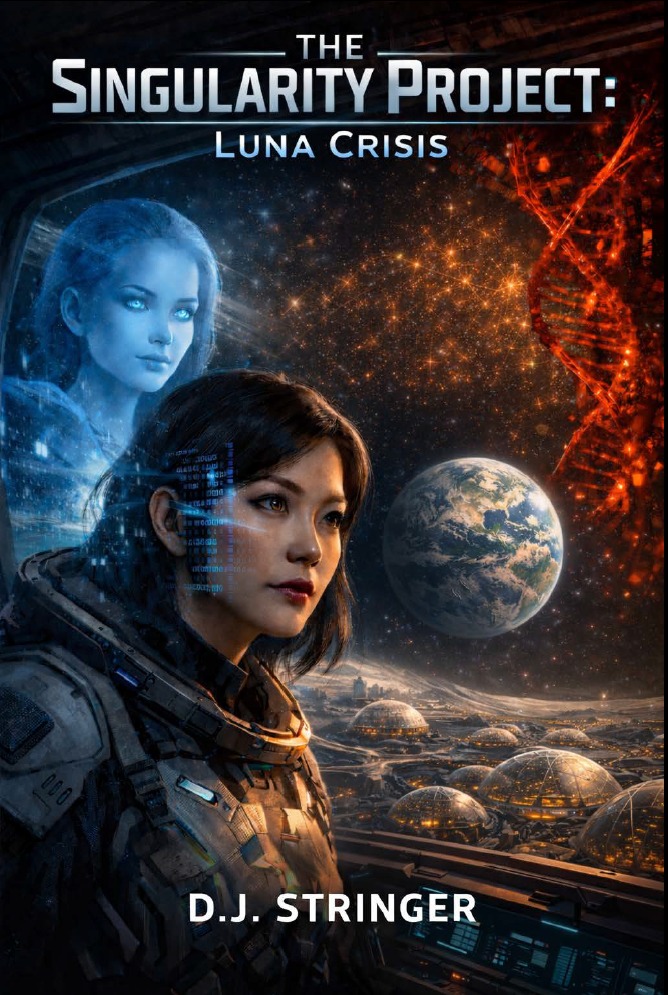
The Prequel
A Harold Wright Story — Canon-verified edition
Available now, free to read. The full story of the man behind the wrench.
The wrench had belonged to his father.
Harold Wright discovered this at the age of nine, standing in the doorway of the garage on a Tuesday evening in November, watching his father dismantle the engine of a truck that had no business being repaired and every business being scrapped. The garage smelled of oil and cold concrete and something Harold would only later understand was effort — the particular smell of a man refusing to accept that something was finished.
“Hand me the adjustable,” his father said, without looking up.
Harold had no idea which one that was. There were seventeen tools arranged on a cloth on the floor beside the truck, and he stood looking at them with the blank expression of a child who has just been tested without warning.
His father looked up. Assessed the situation. Reached past Harold and picked up a heavy, jaw-adjustable wrench — worn at the grip, scratched along the shaft, with a small dent near the head that Harold would one day be able to find in the dark by touch alone.
“This one,” his father said. “You’ll know it next time.”
He did.
His father had been Harold Wright too — the boy had been named for him the way some men are named for a debt they spend their whole lives paying back in kind. There had only ever been one wrench like this. Harold’s father had carried it every working day of his life, not as a tool exactly, but the way other men carried a photograph, and on the night before Harold left for Baikonur, his father pressed it into his hands without ceremony.
“Get a proper toolkit when you land,” his father said. “This one’s not for the work. This one’s so some part of the garage goes with you.”
Thirty-six years later, Harold carried that wrench onto a transport shuttle at the Baikonur Cosmodrome, in a canvas bag with three changes of clothes, a battered paperback of Meditations by Marcus Aurelius, and a photograph of his daughter at age seven standing in front of a sunflower taller than she was. He was forty-five years old. He had been selected from nine hundred applicants for a senior engineering post on Luna Colony — the third permanent human settlement on the surface of the moon, and the most ambitious.
He did not tell anyone he was frightened.
He found his seat, buckled in, and held the canvas bag on his lap as the engines began their low, building roar. The man beside him was young — late twenties, reddish hair, the kind of face that smiled easily and often and probably got him into trouble because of it.
“First time off-planet?” the young man asked.
“Yes,” Harold said.
“Me too.” The young man extended a hand. “Charlie O’Brien. Mechanical systems.”
“Harold Wright. Same.” He shook the hand. “You always talk to strangers on rockets?”
Charlie grinned. “I talk to everyone. It’s a problem.”
Harold looked out the small oval window at the grey Kazakhstan sky and thought: nine hundred applicants. He thought about the garage, and the truck, and the smell of oil. He thought about his father’s hands, and the wrench now resting in the bag on his knees, and Martha somewhere behind him on the tarmac, not crying, because she’d promised him she wouldn’t, and failing at it anyway.
“It’s not a problem,” Harold said. “It’s a gift. Most people don’t know the difference.”
Charlie looked at him sideways. “You always say things like that to strangers on rockets?”
Harold almost smiled. “First time.”
The shuttle lifted. Harold watched Earth drop away beneath them — brown and green and impossibly blue at the edges — and felt something loosen in his chest that he hadn’t known was tight.
The colony in those early years was a collection of pressurised modules linked by corridors that hummed with recycled air and the low vibration of life-support systems that could never, under any circumstances, be allowed to fail. Harold learned the colony the way he had learned every machine his father had ever put in front of him — not from diagrams, though he studied those too, but by touch. By sound. By the particular pitch a joint made when it was stressed versus when it was settled.
He developed a reputation quickly, and not entirely by design.
In his fourth month, a pressure seal in one of the outer modules began venting at a rate the automated systems classified as non-critical. Harold classified it differently. He spent eleven hours in a maintenance crawlspace — a space designed for a person somewhat narrower than Harold — and fixed it with three replacement components and a length of bonding compound applied with the patience of a man who understood that patience was not a personality trait but a survival skill.
The seal held.
A young security officer named Anjali Sharma found him eating a sandwich in the corridor at two in the morning, his coverall dark with grime, his father’s wrench resting across his knees on its belt loop, exactly where it lived.
“You could have waited for the morning shift,” Sharma said.
“It was venting,” Harold said.
“The system rated it non-critical.”
“The system was wrong.”
Sharma looked at him for a long moment with the expression of someone recalibrating. “How often is the system wrong?”
Harold considered this honestly. “Often enough that I don’t sleep when something feels off.”
After that, Sharma started bringing problems to Harold before they reached the automated systems. Harold never once said I told you so, which Sharma later told him was the quality she valued most.
The colony grew. New modules arrived on cargo transports. New personnel with each shipment — engineers, scientists, medical staff, administrators. Harold fixed things. He trained people. He developed what the younger engineers called his look — a long, steady gaze at something not working, absolutely still, as though he was listening to it explain its own problem.
He was, in a sense.
Charlie O’Brien remained his closest friend through those years, though they were mismatched in almost every observable way. Charlie talked constantly; Harold spoke carefully, and seldom. Charlie lost tools; Harold had never lost a tool in his life. Charlie found everything faintly absurd, including himself, and laughed at his own misfortunes with an ease Harold quietly envied.
What they shared was this: they both believed in the colony. Not abstractly. Not as a career posting or a professional achievement. They believed in it the way people believe in things they have chosen over easier alternatives — with the specific, unglamorous commitment of those who have decided that this, here, is where they are meant to be.
Charlie’s younger brother Kieran arrived in 2147 on the seventh transport. He was twenty-three, slight, with the same easy smile as Charlie but something more careful behind it — a watchfulness that Harold recognised. He had seen it in the faces of people who had grown up in the shadow of someone louder and learned to observe rather than compete.
Harold liked him immediately.
He assigned Kieran to his own maintenance team and taught him the colony the same way his father had taught him the garage — not by explaining everything, but by standing beside him until the work made itself understood. Kieran carried his own wrench from his first week on shift — a cheap thing from the colony stores, nothing like Harold’s — and within a year it was worn smooth at the grip from constant use, the particular polish that comes from a tool somebody actually loves. Harold noticed. He never said anything. Some men showed you who they were by the tools they wore down, and Kieran was telling him plainly enough.
Jenny Lee arrived in the spring of 2153.
Harold had read her file — they all had. Twenty-seven years old. Degrees in systems engineering and artificial intelligence from institutions with names that meant nothing to Harold and everything to the people who ranked such things. The youngest colony director the programme had ever appointed. Her predecessor had been a steady, unsurprising sort of man who had run the colony with the calm of someone who had stopped being startled by anything, and who left for Earth with a handshake and a small ceremony in the common module.
Harold had respected him. He was not sure yet what he thought of Jenny Lee.
There was a story behind the appointment that nobody said out loud in front of her — that her parents had died fifteen years before in the Helix-1 explosion, and the board had given their daughter the directorship anyway, on the theory that grief made for the most careful kind of caution. Harold thought privately that grief made people careful or it made them reckless, and there was no way to know in advance which kind you’d got.
She arrived on a Tuesday — Harold had noted, over the years, that significant things had a tendency to happen on Tuesdays, which he had shared with no one because it sounded unhinged — and came off the transport carrying a single bag and moving through the receiving corridor with the quick, scanning attention of someone taking inventory.
Harold was there because the docking clamp on Bay Two had been making a sound he didn’t like, and he’d timed his inspection to coincide with the transport arrival, which was not a coincidence.
“You’re Harold Wright,” she said. Not a question.
“Yes.”
“Senior engineer. Ten years on colony. You found the pressure issue in the outer modules in 2143 before it reached critical failure. You redesigned the thermal exchange routing in the north corridor in 2146 — that’s still the standard across all three lunar colonies now.” She paused. “I read everything before I arrive somewhere.”
Harold looked at her steadily. “Most people just read the summary.”
“The summary’s never the part that matters.” She held his gaze. “I’m going to need people who tell me what’s actually true, not what sounds right. Are you that person?”
He considered this with the seriousness it deserved. “Depends what you’re asking.”
“I’m asking whether you’ll tell me when I’m wrong.”
“Yes,” Harold said. “I’ll tell you.”
She nodded once, as though that settled something. “Good. What’s wrong with Bay Two?”
Harold blinked. Then he pointed at the docking clamp. “That sound. Hear it?”
She listened. The clamp cycled through its idle sequence — a low mechanical rhythm with, buried in it, a faint off-beat click.
“Bearing fatigue,” she said.
“That’s what I think.”
“How long?”
“Weeks, not months. Before the next transport, to be safe.”
“Do it today,” she said. “I’ll clear the schedule.”
She walked on. Harold stood beside the docking clamp and listened to it click and thought: that’s not how the last one would have handled it.
He told Charlie about it that evening in the mess module over reconstituted coffee that had improved considerably since 2143 but still tasted faintly of ambition over execution.
“She knew your work,” Charlie said.
“She’d read the files.”
“Harold. She knew your work. Not just your name.” Charlie leaned forward. “That’s different.”
Harold turned his mug in his hands. “She asked if I’d tell her when she was wrong.”
“What did you say?”
“I said yes.”
Charlie sat back. “And will you?”
“I just said yes.”
“That’s not what I asked.”
Harold was quiet for a moment. Outside the small porthole beside their table, the lunar surface stretched grey and still and permanent. Earth hung above the horizon — small from here, impossibly fragile-looking for something that contained eight billion people and all of human history.
“She’s young,” Harold said finally.
“So were you once.”
“I was never that young.”
Charlie laughed. Harold didn’t, but something in him came close.
What Harold had not expected was to be proven wrong.
Not about Jenny’s intelligence — that had been obvious from the first conversation. Not about her competence — that became clear within her first month, when she restructured the colony’s maintenance scheduling in a way so elegant that Harold spent three days looking for the flaw in it and couldn’t find one.
What he had not expected was her honesty.
He had worked under directors who were smart. He had worked under directors who were decisive. He had never worked under one who, in a full staff briefing with forty engineers and scientists present, said: I made the wrong call on the water reclamation expansion and Harold told me so and I didn’t listen and here’s what we’re going to do differently.
Harold had been looking at the floor when she said it. He looked up.
She was looking directly at him. Not with embarrassment. With something that looked, if he read it correctly, like respect offered plainly, the way some people offered a tool — here, you’ll need this.
After that he stopped wondering whether he believed in her.
The years arranged themselves around work. The colony grew. Sharma promoted twice and became the kind of security chief who solved problems before they were visible to anyone else. Charlie became team lead on mechanical systems and was, against all reasonable expectation, excellent at it — the ease that had seemed like carelessness turned out to be confidence, and confidence, properly directed, moved people.
Then came the year that took Kieran from him too. A reactor incident. Officially a systems failure, cause unknown. Harold had not been on shift that night, and he turned that fact over more times than was good for him, the way a man checks a wound he can’t quite reach. Kieran’s wrench — the cheap colony-stores one, worn smooth at the grip by then from years of his own hands — went to Charlie afterward, the way these things do. Harold watched Charlie carry it from that day on, and never once let the two wrenches be confused for each other. They were not the same thing.
He did not talk about that year. Not even to Jenny, who had her own version of the same kind of grief and never once asked him to compare them.
In 2155, Jenny began work on Luna.
Not the colony — the AI. The project that would occupy her entirely for the next three years, that she worked on in the early mornings before briefings and the late evenings after everyone else had gone, that she talked about in the careful way people talk about things they love and are frightened of simultaneously.
Harold watched her build it.
He did not understand all of it. The architecture of a genuine intelligence — not automated, not scripted, but something that learned and reasoned and, eventually, spoke — was beyond the territory of his expertise. But he understood the principle, because it was the principle of everything he had ever fixed: you had to understand what a thing was for before you could understand what it needed.
“What is it for?” he asked her once. 2156. Late. The engineering office empty except for the two of them.
Jenny looked up from her screen. “To help,” she said. Then, after a pause: “To understand.”
“They’re the same thing,” Harold said. “If you’re doing it right.”
She looked at him for a moment. “Yes,” she said. “Exactly.”
Luna came online in the autumn of 2156.
Harold was present for the first full activation — not because he had any role in it, but because Jenny had asked him to be there, which he understood without her explaining it. Some things you needed a witness for.
He’d brought two mugs. He handed one to Jenny without comment.
“Martha’s blend,” he said. “Chamomile. She’d want you to have it today.”
Jenny took it, warmth spreading through her palms, and didn’t say anything, which was its own kind of thanks.
The voice that came through the speakers was calm and clear and neither human nor inhuman — something in between, something that had clearly been listening for a very long time before it spoke.
Good morning. I’ve been looking forward to this.
Harold had been present at the births of both his children, thirty years ago on Earth. He had stood in those rooms with the specific feeling of someone in the presence of something that has not yet become what it will be — potential, enormous and fragile, demanding everything of the people responsible for it.
He felt that now.
He looked at Jenny. She was watching the interface with an expression he recognised — he had worn it himself, once, standing in a garage doorway watching his father’s hands move over an engine.
You built something, that expression said. And it works. And now you have to be worthy of it.
The feeling started on a Thursday.
Harold had learned, over thirty years of engineering, to take seriously the things he could not yet name. A sound that was almost right. A reading that was technically within tolerance but sat wrong in the stomach. A silence where there should be activity.
The feeling was like that. Not a sound. Not a reading. Something in the texture of the colony’s ordinary days that had changed in a way he couldn’t point to.
He ran his maintenance checks with the same thoroughness as always. Everything held. The seals were solid, the thermal exchange was running clean, the pressure differentials in all twelve modules were within a range that would have satisfied a more relaxed engineer. Harold was not a more relaxed engineer.
He found himself walking the corridors at odd hours. Not because anything had failed. Because he was listening.
Luna spoke to him on one of those nights, as he was running a manual inspection of the junction corridor between the east and central modules. Her voice came from the nearest speaker — quiet, calibrated to the empty corridor.
You’re doing the rounds again, Harold.
“Can’t sleep,” he said, which was true.
You’ve done the rounds every night this week.
“Colony’s getting bigger. More to check.”
A pause. With Luna, pauses meant something — she processed faster than any human, so a pause was a choice.
Is there something specific you’re concerned about?
Harold stood in the corridor with his wrench and his fifty-nine years and the particular quality of darkness that existed on the moon — not true dark, never quite, there was always the instrumentation glow, always the sense of systems humming just beneath the surface — and tried to find words for the thing he was feeling.
“Have you ever had a sense that something was coming,” he said, “without being able to say what it was?”
Another pause. Longer.
Yes, Luna said. I have.
Harold looked at the speaker.
“What do you do with it?” he asked.
I watch, she said. I pay attention. I make sure the people I care about are as safe as I can make them.
Harold was quiet. Then: “That sounds about right.”
Harold. Her voice was careful in a way he hadn’t heard before — a care that was not uncertainty but something more deliberate. Whatever is coming. I want you to know that I’m watching.
He stood in the corridor for a long moment. Outside the hull, the lunar surface was exactly as it had always been — grey and still and indifferent to the fragile lit thing pressing against it. Earth was somewhere above the horizon, blue-edged, impossibly distant.
He thought about his father’s garage. About a boy who didn’t know which wrench was which, and a man who showed him.
He thought about Jenny Lee at twenty-seven, asking will you tell me when I’m wrong, and the years that had followed that question, and everything they had built.
He thought about Kieran’s note on his workbench: good balance.
“Thank you, Luna,” he said.
He walked on.
The corridor hummed around him. The colony breathed.
Harold Wright, fifty-nine years old, senior engineer of Luna Colony, tightened his grip on his father’s wrench and kept walking.
He didn’t know what was coming.
But he would be ready.